Blue Max – The Speed and Precision of Air Combat on the Atari 800
Blue Max is an action game developed by Synapse Software and released in 1983, considered one of the brightest gems among Atari 8-bit computers. Bob Polin was responsible for the game’s design, successfully combining a simple concept with an exceptionally polished execution in a way that still resonates with players today. The Atari 800 version is not merely a technical feat, but a cohesive whole in which gameplay, rhythm, and audiovisual presentation support one another in an exemplary manner.
At the heart of the game is a top-down aerial combat sequence where the player controls an airplane flying over enemy territory. The objective is to destroy bridges, buildings, and anti-aircraft guns while dodging enemy planes and constant fire. The screen scrolls smoothly downward, creating a sense of advancing through enemy lines. This constant movement gives the game an intense rhythm: the player has little time to stand still, but must make decisions quickly and precisely. Technically, Blue Max is an impressive achievement. The Atari 800’s hardware is utilized effectively, and the screen scrolling in particular is astonishingly smooth for its time. Terrain details—rivers, bridges, and buildings—stand out clearly, which not only enhances visual appeal but also supports gameplay. The player can quickly assess the environment, which is critical for survival. Additionally, explosion effects and animations add a sense of dynamism that makes every successful attack rewarding. Controls are one of the game’s key strengths. The plane responds precisely to the controls, and altitude management is clear and logical. This makes the game accessible but by no means easy. The difficulty level rises steadily, and the number of enemies as well as the intensity of fire force the player to hone their skills. The limited supply of fuel and ammunition introduces a light element of resource management, adding a strategic dimension to the otherwise straightforward action. The soundscape is simple yet effective. The roar of the engine, explosions, and hits provide sufficient feedback to the player without becoming overwhelming. Although music isn’t central, the sound effects support the game’s pace and help build a tense atmosphere. The overall experience works exactly as well as you’d expect from a game like this.
Blue Max doesn’t aim to be a complex or story-driven experience; its strength lies in pure gameplay. It’s a game that rewards practice and focus, and one that’s easy to return to time and again. This is precisely what makes it a timeless classic: its core concept is clear, but the execution is deep enough to keep you engaged for a long time. The game is featured in the I love 8-bit® computer exhibition, where it can be played on the original Atari 800, as well as on the Commodore 64 and Sinclair ZX Spectrum. This context highlights the game’s historical significance and gives modern players the chance to experience what a cutting-edge home computer game felt like in the early 1980s. At the same time, it serves as a reminder of just how inventive and ambitious game developers were in an era of limited resources.
Overall, Blue Max is an excellent example of how technical expertise and strong game design can come together to form a seamless whole. It may not have revolutionized the gaming world as radically as some of its contemporaries, but its polish and playability make it one of the most enduring and enjoyable games of its era.
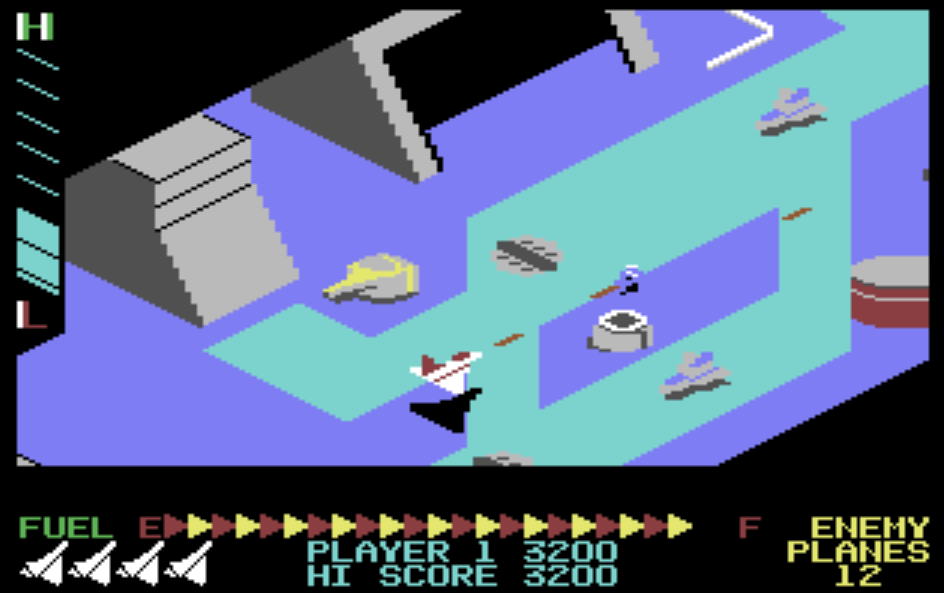
Zaxxon is one of the early games that truly strives to create a three-dimensional effect on a two-dimensional screen. The Commodore 64 version of this classic carries with it both the ambition of the original arcade game and the limitations of the home computer era, making it an interesting but somewhat contradictory experience. At the heart of the game is an isometric view, which was exceptional for its time. The player steers a spaceship through enemy bases, dodging obstacles and shooting enemies. Altitude control is an essential part of the game mechanics, adding strategic depth: fly too low and you’ll crash into obstacles; fly too high and you’ll be more vulnerable to enemy fire. This makes the gameplay exciting, but also frustrating at times, as the controls aren’t entirely precise on the C64.
Audiovisually, Zaxxon is ambitious but not entirely convincing. The graphics are recognizable and attempt to preserve the look of the arcade version, but the level of detail is inevitably more modest. The colors are a bit flat, and the animations are stiff in places. The soundscape is minimalist and doesn’t add much to the atmosphere, but it gets the job done. The gameplay’s greatest strength is its originality. The isometric perspective sets it apart from many shooters of its time, and it demands more spatial awareness from the player than traditional side-scrolling games. At the same time, this is also its weakness: the game isn’t very forgiving, and the learning curve can feel steep. Overall, the C64’s Zaxxon is an interesting piece of gaming history. It isn’t a perfect port of the arcade hit, but its innovative perspective and challenging gameplay make it a memorable experience. It represents a time when game designers dared to experiment with new ideas, even though technical limitations set clear constraints.
Zaxxon is an arcade game originally developed and published by Sega in 1982, which was ported to the Commodore 64 in 1984. The C64 version is based on this original release and brings the isometric space shooter to home computers. The game is featured at the I love 8-bit® computer exhibition, where it can be played on an authentic Commodore 64, offering a tangible connection to 1980s gaming culture.
In the late 1970s, one of the most significant shifts in the history of information technology took place: computers moved from businesses and universities into the homes of ordinary people. The years 1979–1980 were pivotal in this transition. The computer was no longer just a tool for experts; it began to evolve into a consumer product—the home computer. Until the mid-1970s, computers were primarily large and expensive systems. Although devices aimed at hobbyists, such as the Altair 8800, existed, they required technical expertise and assembly. It was not until the end of the decade that pre-assembled, relatively affordable microcomputers appeared on the market.
The boom is about to begin
By 1979, the first wave—including the Apple II and TRS-80—had already demonstrated that there was demand among private individuals. Now a second wave began, in which devices evolved and competition intensified. The arrival of home computers in households in 1979–1980 marked a fundamental shift in how technology was understood and who it belonged to. As late as the early 1970s, computers were large, expensive, and difficult-to-use systems that primarily served science, government, and large corporations. By the end of the decade, the situation began to change rapidly as the first relatively affordable and compact home computers appeared on the market. News coverage often described this shift as a revolution: the computer was no longer a distant and mysterious machine, but a potential part of everyday life. The arrival of home computers in households signaled, above all, a new kind of relationship with technology. Users were no longer merely consumers of ready-made systems, but active participants. Computers often required programming, and many people learned to write simple programs immediately after purchasing a device. This created a culture centered on experimentation, DIY, and technical curiosity. The computer was not just a device, but a hobby and a learning tool.
A rapid impact on culture
This shift began to manifest in culture quickly, albeit cautiously. Magazines and special publications presented computers as a new, exciting phenomenon, and they published program code that readers could copy and try out for themselves. Computers were associated with the promise of the future: they were seen as tools that would transform work, education, and leisure. At the same time, they began to appear in advertising as part of a modern lifestyle. A family that owned a computer was portrayed as progressive and in tune with the times. From an entertainment perspective, home computers were strongly linked to games. Many early users bought a computer specifically for gaming, and this influenced how the devices were marketed and portrayed in the media. However, games were not merely a pastime but also a gateway to the world of programming: users could modify or create their own games. This combination of entertainment and creative activity was a key part of the appeal of home computers.
But who were these intended for?
The question of who computers were intended for was central and, to some extent, open-ended in 1979–1980. Manufacturers and the media targeted their messages at several groups simultaneously. On the one hand, computers were marketed to families and children as learning tools that would prepare young people for the information society of the future. On the other hand, they appealed to hobbyists and tech-savvy adults who wanted to understand and master the new technology. Additionally, small business owners and professionals began to see home computers as useful tools, for example in bookkeeping. In reality, however, early home computers were still devices for a limited user base. Price, technical complexity, and a scarcity of software limited their spread. Users were often educated, technically oriented, or otherwise particularly interested in new technology. Despite this, even during these years, the image of the computer as a necessity of the future began to take shape. The arrival of home computers in households in 1979–1980 was thus a turning point both technically and culturally. It changed perceptions of the computer, brought it into popular culture, and laid the foundation for widespread digitization. Although the phenomenon was still in its early stages, its effects reached far into the future.
The year 1979 laid the groundwork for the future of home computers
In summary, it could be said that the rise of home computers in 1979–1980 marked a significant change in both technology and the way the media covered information technology. Previously, computers were mainly associated with large organizations, such as universities and businesses, but during these years, news coverage began to highlight a new phenomenon: the transition of computers into the homes of ordinary people. In 1979, news coverage focused particularly on the versatility of these devices. The new home computers were not merely calculators; they could be used for gaming, programming, and learning the basics of information technology. This sparked a debate over whether they were more entertainment devices or serious tools. At the same time, the media began to recognize the potential of computers in education and recreational activities, which significantly expanded their target audience. Another key theme was practical use. Programs released in 1979, such as spreadsheet applications, demonstrated that computers could offer concrete benefits in areas like financial management and business operations. This fundamentally changed news coverage: the computer was no longer just a technical curiosity, but a tool with practical value in everyday life. By 1980, attention shifted increasingly toward price and accessibility. News reports emphasized the importance of cheaper models, as they enabled computers to reach a wider user base. Computers began to be discussed as consumer goods that might one day be found in every home, just like televisions. In addition, news coverage depicted fierce competition among different manufacturers. The features of various models were compared in detail, and technical specifications, such as memory capacity and graphics, became central topics of discussion. This laid the foundation for later developments in the IT market. Overall, news coverage from 1979–1980 reflected a transitional phase: the computer was evolving from a specialized tool for the few into a technology affecting the entire society. This transformation laid the groundwork for the subsequent digital age.
1979-1980: Atari led the way, and others followed
In 1979, Atari launched the Atari 400 and 800 models. They were technically advanced: they were based on an 8-bit MOS 6502 processor and separate graphics and sound chips, which enabled smooth graphics and multi-channel sound. This was a significant step. Earlier home computers were often very limited, but Atari brought game console-like features to the computer. The home computer began to be seen as an entertainment device, not just a calculator. At the same time, there were already several options on the market: the Commodore PET, Apple II, and Tandy TRS-80 were competing with one another. By 1980, these computers had already sold tens or hundreds of thousands of units. The year 1980 brought with it perhaps an even greater change: prices began to fall and the devices became simpler. In 1979, Atari launched the Atari 400 and 800 models. They were technically advanced: they were based on an 8-bit MOS 6502 processor and separate graphics and sound chips, which enabled smooth graphics and multi-channel sound. This was a significant step. Earlier home computers were often very limited, but Atari brought game console-like features and lowered the barrier to entry so much that a computer became a realistic purchase for the average household.
At the same time, the American company Commodore was preparing for its own breakthrough. Introduced in 1980, the VIC-20 was one of the first computers to be sold widely in department stores rather than just specialty shops. This was decisive: the computer moved from the world of electronics hobbyists to the consumer market. The VIC-20 later became the first computer to sell over a million units. It demonstrated that the home computer was not just a niche product, but a mass-market commodity. Texas Instruments (TI) entered the market with its TI-99/4 computer, which used a 16-bit architecture—a technically advanced solution for the era. However, it did not achieve the same level of popularity as its competitors, partly due to its higher price and more closed ecosystem. In addition, there were numerous other manufacturers on the market: Sharp, Acorn, Mattel, and many smaller companies. In the early 1980s, there were dozens of home computer models that were incompatible with one another. This fragmentation among manufacturers and models was typical of the early days, but it was precisely what made the computer culture of the time so rich, as there were many options.
The empire strikes back
A key player here was the British company Sinclair. Its ZX80 was released in 1980 and was an exceptionally inexpensive computer. It offered basic functions—a keyboard, a display connected to a television, and the BASIC programming language—but with a stripped-down design. For example, the membrane keyboard and limited memory made it modest but accessible to the masses. The significance of the Sinclair ZX80 was not technical but economic. Sinclair 1979: Atari and a new level for home computers The release of the Atari 400 in 1979 significantly intensified competition in the home computer market and forced other manufacturers to refine their strategies. The Atari stood out in particular for its advanced graphics and sound capabilities, which stemmed from the company’s strong background in game consoles. This set a new standard for what could be expected from a home computer for entertainment purposes, and competitors were forced to react quickly.
The prices fell soon
One key response was intensified price competition. Commodore, in particular, aggressively sought to lower prices and bring more affordable models to market. The goal was to make the computer a mass-market product accessible even to consumers for whom Atari’s devices were still too expensive. This strategy was later clearly evident, for example, in the success of the VIC-20, but its roots lay in the pressure caused by the Atari 400. Another significant reaction concerned the positioning of the devices. Whereas Atari placed a strong emphasis on entertainment and games, many competitors sought to differentiate themselves by highlighting practical applications. For example, Apple and Tandy (TRS-80) focused their marketing on the needs of education, programming, and small businesses. In this way, they created an alternative narrative: the computer was not just a gaming device, but a serious tool for learning and work. On a technical level, competitors also began to pay more attention to graphics and sound, although not all were immediately able to match Atari’s level. This led to a gradual evolution in which the importance of multimedia grew across the entire industry. At the same time, software developers began to take advantage of new features, which also increased pressure on other manufacturers’ hardware development. In addition, changes occurred in distribution and marketing. Atari leveraged its strong brand and visibility in the consumer electronics sector, which forced competitors to invest in visibility in department stores and broader advertising. Computers were no longer sold only in specialty stores; instead, they began to be integrated into everyday consumer culture. Overall, the competition brought by the Atari 400 accelerated the maturation of the home computer market. It forced manufacturers to clarify their target groups, develop their products, and compete on price, features, and brand image. This dynamic laid the foundation for the rapid growth and widespread adoption of home computers in the early 1980s.
The era of golden computing is back to the future in Helsinki, Finland
The showroom of The Computer Museum of Kallio, Helsinki Finland (2024-2026)
In the heart of Helsinki, lies a gateway to a time when computers were not yet invisible pocket tools, but large, humming machines that sparked the imagination. The Computer of Museum of Kallio is not a traditional storage space locked behind glass display cases, but a lively and interactive environment dedicated to the golden age of home computing in the 1970s and 1980s.
The atmosphere of 1984 and an exploratory approach
The museum’s core concept is designed to evoke a computer store from 1984. This choice is no coincidence; the year 1984 marks a turning point when home computers began to truly take over Finnish living rooms. The museum’s approach is based on the “hands-on” principle: the devices have been restored to working order and await active interaction.
The museum’s activities are exploratory in nature. It does not merely showcase technology but seeks to understand the social and cultural significance of the home computing era. Visitors can concretely experience how programming, games, and digital creativity emerged under the constraints of limited performance. The “research” conducted at the museum is often peer-based: enthusiasts and experts share knowledge about the architecture, repair, and software history of old devices.
An open door to the history of home computing
One of the museum’s most important principles is accessibility. Anyone can come and explore devices from the golden age of home computing. No prior technical knowledge is required; curiosity is enough. Visitors can sit down at a Commodore 64, a Spectrum, or an old Macintosh and immediately experience what the digital world felt like before the internet era. This accessibility makes the museum a significant educational institution. For younger generations, it offers a chance to look “under the hood,” while for older visitors, it’s a nostalgic journey back to their own youth. The museum’s I love 8-bit® exhibitions serve as a bridge here: they invite visitors to experiment, play, and gain insight into the long-term trends of technological development. The Computer Museum of Kallio is more than just a collection of metal and plastic. It is a communal space that cherishes the legacy of home computing by offering opportunities for hands-on exploration and experiences. In the basement on Alppikatu, history isn’t dusty text on a wall; instead, it flickers on CRT screens and crackles from floppy drives—inviting every visitor to join an expedition to the roots of information technology.
The Computer Museum on demand
And the best part is yet to come: the museum is bringing these experiences into the future—and not just in Helsinki. You can have your own version of The Computer Museum of Kallio delivered right to your location. The Computer Museum of Kallio builds custom museums and showrooms on demand. The museum creates amazing experiences around the world.
By the mid-1980s, Apple had already established itself as a leader in the personal computing revolution. The Apple II series, beginning in 1977, had brought computers into homes, schools, and small businesses, and models like the Apple IIe had cemented the brand’s reputation for reliability, expandability, and educational value. Yet despite these successes, Apple faced a challenge: the market was changing. Computers were becoming more compact, portable, and user-friendly, and competitors such as IBM, Commodore, and Atari were introducing machines designed to appeal to consumers who wanted more convenience and style. Into this context came the **Apple IIc**, released in April 1984, a computer that combined the proven architecture of the Apple II with a new vision of portability and elegance.
The Apple IIc, or “compact,” was designed to be a fully self-contained, lightweight version of the Apple IIe. It retained the familiar **MOS 6502 processor**, running at 1 MHz, and was compatible with the existing Apple II software library, ensuring that users could access hundreds of titles without concern for compatibility. Memory was configurable at 128 KB, expandable to 1 MB through special RAM cards, giving it sufficient capacity to run both games and professional applications. Unlike previous Apple II models, which were often bulky and required separate keyboards, monitors, and peripheral boxes, the IIc integrated the keyboard and mainboard into a single portable chassis, roughly the size of a modern briefcase. Its off-white, sleek plastic case was designed to evoke modernity and convenience, signaling Apple’s intention to make computing more approachable to a broader audience.
For educational institutions, the IIc was particularly appealing. In the mid-1980s, schools around the United States and parts of Europe were increasingly adopting personal computers as teaching tools. The Apple IIc’s portability allowed teachers to move machines between classrooms and labs, while its compatibility with existing Apple II software meant that school districts could leverage their investments in educational programs. In Finland, where Apple IIe and IIc machines found a small but enthusiastic following, the IIc offered similar advantages: a professional-grade computer that could be transported easily, used for programming instruction, and run local or imported educational titles.
The Apple IIc’s software ecosystem was one of its greatest strengths. By 1984, the Apple II platform had an extensive library of programs, including word processors like **AppleWorks**, spreadsheets like **VisiCalc**, educational software like **Logo** and **The Oregon Trail**, and countless games. Users could transition seamlessly from one model to another, and software purchased for an IIe would run on the IIc with little or no modification. The combination of portability, compatibility, and style made the IIc particularly attractive to home users who wanted a complete computing solution without the clutter and complexity of full-size desktops.
Critics at the time praised the Apple IIc for its build quality, portability, and elegant design. Reviewers noted that the machine was quiet, reliable, and relatively easy to set up, especially compared to earlier Apple II models, which could be intimidating for first-time users. Its limitations were also noted: the lack of internal expansion slots meant that hobbyists and power users could not extend it as extensively as the IIe, and the reliance on external floppy drives was seen as less convenient than integrated storage solutions emerging in other systems. Still, the overall reception was positive, particularly among consumers and educators who valued convenience and consistency.
Apple’s marketing of the IIc emphasized portability and ease of use. Advertisements showcased students carrying the computer between classes, families using it in living rooms, and professionals transporting it to offices. The message was clear: the IIc was designed for a new kind of user, one who wanted the power of the Apple II without the bulk and complexity of earlier models. This approach anticipated broader trends in personal computing that would come to dominate in the late 1980s and 1990s, including the development of laptops and portable workstations.
The Apple IIc also highlighted Apple’s philosophy of **design and user experience**. While competitors were often focused on raw power or low cost, Apple emphasized integration, aesthetics, and simplicity. The IIc embodied these principles: a compact, visually appealing machine that delivered reliable performance and maintained the brand’s commitment to quality. Its introduction reflected Apple’s dual strategy in the 1980s: continue serving existing Apple II users while attracting a new audience with a machine that was approachable, stylish, and portable.
The broader impact of the Apple IIc is also notable. It extended the Apple II family into new markets, providing an option for users who might have been deterred by the size or complexity of the case. Its release reinforced Apple’s dominance in schools and among small businesses, ensuring that the Apple II ecosystem remained relevant even as the Macintosh line began to take shape. By maintaining compatibility with existing software, the IIc helped preserve a generational knowledge of computing skills, bridging the gap between early Apple II machines and the coming Macintosh era.
In retrospect, the Apple IIc represents both continuity and innovation. It continued the Apple II legacy of reliability, educational value, and software richness, while introducing portability and integrated design that anticipated the future of personal computing. The Apple IIc’s influence extended beyond its immediate sales: it demonstrated that computers could be both powerful and compact, professional and approachable, functional and stylish. For many users, it was their first introduction to the Apple ecosystem, providing a platform for learning, creativity, and productivity.
Looking at the Apple II series as a whole, one can trace a remarkable trajectory. It began in 1977 with the original Apple II, a machine that made personal computing accessible to hobbyists and early adopters. It evolved through the II Plus, IIe, and IIc, each iteration refining the user experience, expanding capabilities, and broadening the market. Later models, such as the Apple IIGS, brought color graphics, improved sound, and enhanced performance while retaining backward compatibility. The Apple II family remained in production for more than 15 years, officially ending in 1993. This longevity is a testament to the design, versatility, and cultural impact of the series, which laid the groundwork for Apple’s later successes and established computing as a household and educational necessity.
Ultimately, the Apple IIc is remembered as a milestone in that journey: a machine that combined elegance, portability, and reliability with the rich software heritage of the Apple II. It was not the most powerful computer of its time, nor the most expandable, but it represented a philosophy that continues to influence personal computing today: integration, usability, and thoughtful design. For those who owned it, the IIc was more than hardware; it was a tool for creativity, learning, and exploration — a compact window into the expanding world of the digital age.
Apple IIc & California Games at the I love 8-bit® exhibition 2025 in Helsinki